When I started working as a pelletizing line supplier over a decade ago, one question popped up at almost every industry trade show, every client call, and every site visit: “Can you build a line that works exactly for my material?” At first, I’d give the generic answer any sales rep might use—“We have standard models, and we can make a few tweaks”—but after working side-by-side with hundreds of processors, I learned that customization isn’t just a nice-to-have feature. It’s the core of what makes a pelletizing line actually useful. Pelletizing Line

Let’s back up for a second to what a pelletizing line does, just to set the stage. If you’re processing plastic recyclables, rubber compounds, food-grade ingredients, or even some types of fertilizer, a pelletizing line turns bulk, messy raw material into consistent, easy-to-handle pellets. That consistency is what matters most: uniform size, minimal dust, stable melting point for your next processing step, and no unexpected downtime mid-run. One size does not remotely fit all here. A line built for processing post-consumer PET bottles is way different from one designed for medical-grade polypropylene, and even two processors working with the same material might have totally different needs based on their input, their output, and their floor space.
Take my first big custom job, back in 2014. A small recycler in Ohio reached out, frustrated. They had a 10-year-old standard line, and it kept clogging on the mixed rigid plastic they sorted curbside. Their problem wasn’t just the line itself—it was their raw material: their mix had 15% more heavy PVC than their original line was rated for, and their building only had a 12-foot ceiling. Standard lines that handled PVC needed 18-foot overhead clearances because of their cooling and drying systems. I couldn’t just sell them an off-the-shelf PVC line; it wouldn’t fit. So our engineering team spent four weeks reconfiguring the entire setup: we moved the drying system to a floor-mounted unit, shrank the extruder’s barrel length to fit their smaller space, and adjusted the cutting blade speed to handle the mixed material without clogging. That line still runs for them now, and it’s been a reference for every custom job we’ve done since.
Today, customization for pelletizing lines happens at every stage, not just the big structural tweaks. Let’s break down the most common areas where clients work with us to tailor a line to their specific requirements. First, input material compatibility. If you’re processing post-industrial scrap, your raw material might be consistent, so you can use a standard screw design in the extruder. But if you’re processing mixed, post-consumer plastic—think bottles, containers, film, and caps all mixed together—you need a screw that can handle varying melt temperatures, remove moisture, and separate contaminants without turning your line into a bottleneck. We’ve also built lines specifically for thermoplastic elastomers (TPE), which are softer and more elastic than regular plastic; those require a slower cutting speed and a different cooling method than hard polyolefins. For food-grade or pharmaceutical pelletizing, we adjust every component to meet 3-A or FDA standards: stainless steel with no crevices, food-safe lubricants, and even integrated sanitizing cycles that you won’t find on standard industrial lines.
Next, output specs. Not all pellets are made the same. A pellet size that works for injection molding might be too big for 3D printing filament, for example. A client in Germany came to us a couple of years ago, needing pellets small enough to mix evenly into birdseed pellets, but too uniform to cause dust spillage during packaging. Our standard pelletizers make 3mm to 8mm pellets, so we adjusted the die plate holes to 1.8mm, calibrated the puller speed to match the smaller pellet length, and added a small vibrating screen to separate any fragments. That’s the kind of tweak an off-the-shelf line can’t do—you can’t just swap a die plate on a standard line without messing up the rest of the process. And it’s not just size: some clients need pellets with low melt flow index for heavy-duty parts, others need high MFI for thin films, so we can adjust the extruder’s temperature zones and cooling system to hit exactly the target they need.
Then there’s operational requirements, which are often the most overlooked part of customization. Not every factory has 24/7 operations, not every floor can handle 50,000 pounds of equipment, and not every team has the same level of technical expertise. For a small processor running two 8-hour shifts a day, we might build a semi-automatic line with easy-to-use touchscreen controls and in-line troubleshooting alerts, so their operators don’t need an engineering degree to fix a clog. For a large production plant running 24/7, we add remote monitoring and predictive maintenance sensors, so our team can spot a worn part before it causes downtime, no matter where in the world the plant is. Floor space is another big one: we’ve built lines that are 20 feet long for compact factories, and lines that are 100 feet long for high-volume plants that can spread out. We’ve even designed modular lines that can be expanded later, so a startup doesn’t have to invest in a full large line upfront, but can add components as their business grows.
I’ve heard the skepticism, too. Some clients ask, “Why not just buy a standard line and modify it later?” And the short answer is: modifying a standard line is usually more expensive, more time-consuming, and less reliable than building a custom line from the start. When you build a line around your specific inputs and outputs, every component works in harmony. If you tweak a standard line’s extruder, for example, you might stress the motor or the cooling system, leading to frequent breakdowns. Custom design lets us size every part to your exact needs, so you don’t pay for extra capacity you don’t need, or get stuck with a line that can’t handle your material.
We also work with clients who have unique regulatory requirements, which are part of customization too. For processors in the EU, we ensure lines comply with REACH and RoHS standards for hazardous substances. For clients in countries with limited access to spare parts, we design lines that use commonly available components, so they don’t have to wait weeks for a replacement part if something breaks. Last year, we worked with a fertilizer company in Brazil that needed a line that could pellet organic materials, not plastic, and also meet local agricultural safety standards for dust control. We added a closed-loop dust collection system that works with their existing safety protocols, and adjusted the cutting blades to avoid damaging the organic material’s nutrient content. That’s not a standard line—that’s a line built specifically for their industry, their location, and their product.
Of course, customization does require a collaborative process. It’s not just us designing a line and a client agreeing to it. The best custom projects start with a detailed consultation: we ask for samples of their raw material, their production volume, their target pellet specs, their floor plan, their maintenance capabilities, and even their long-term business goals. We then put together a proposal that outlines every component, the timeline, and the costs, and we walk through every part with the client to make sure it’s exactly what they need. For example, a client might think they need a 1000 kg/hour line, but after reviewing their actual production data, we might suggest an 800 kg/hour line that fits their floor space and budget, without sacrificing output. That’s the value of working with a supplier who’s not just selling equipment, but helping them solve a problem.
I’ve seen first-hand what happens when you don’t customize a pelletizing line. A few years ago, we got a call from a processor who had bought a standard line from another supplier, only to have it break down three months later. They were processing recycled plastic packaging, but the standard line’s screw was too aggressive, tearing the thin film and causing too much material waste. They spent twice the original cost on repairs and modifications, and still couldn’t hit their target yield. When we took a look, we found that a custom screw and a slightly adjusted cooling system would have solved all their problems, and would have cost less than the modifications they already did. That’s why we always emphasize: a pelletizing line is an investment, not a commodity. Buying the cheapest off-the-shelf line might seem like a good deal at first, but if it doesn’t work for your specific requirements, it will end up costing you more in downtime, waste, and repairs.
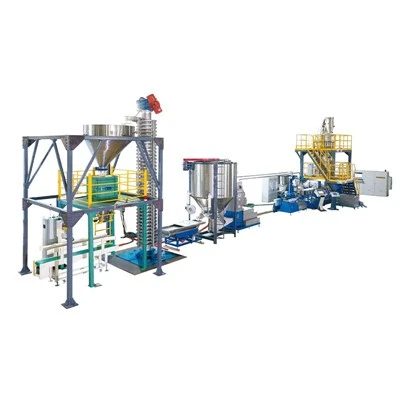
So to circle back to the original question: yes, a pelletizing line absolutely can be customized to meet specific requirements. It’s not a gimmick, it’s how we’ve built our business. Every client’s needs are different—different material, different space, different output, different operational goals—and the best pelletizing lines are built to fit those needs, not the other way around.
Pipe Extrusion Line If you’re tired of lines that force you to compromise on your material, your output, or your budget, let’s talk. We work with processors of all sizes, from small startups to large manufacturing plants, to design and build pelletizing lines that work exactly for what you need. We’ll walk through your requirements, answer your questions, and help you build a line that delivers consistent, reliable results for your business.
References
- Plastic Pelletizing Technology: Principles and Practice. Hanser Publications, 2019.
- “Customization in Industrial Processing Equipment,” Journal of Manufacturing Systems, Vol. 52, 2019, pp. 112-120.
- Food-Grade Pelletizing Standards: Compliance and Best Practices. 3-A Sanitary Standards, Inc., 2021.
- Design Modular Manufacturing Equipment: A Guide for Processors. Industrial Equipment Manufacturers Association, 2020.
Zhejiang Jwell Pipe Equipment Co., Ltd.
As one of the most professional pelletizing line manufacturers and suppliers in China, we’re featured by quality products and good price. Please rest assured to buy cheap pelletizing line in stock here from our factory. Customized orders are welcome.
Address: No.128 Qingfeng Road, Xieqiao Town, Haining City, Jiaxing City, Zhejiang Province
E-mail: salaa@jwell.cn
WebSite: https://www.jwell-pipe.com/
